

Buying a new car is one of the biggest financial decisions most Indian households make — second only to purchasing a home. After months of research, test drives, loan approvals, and insurance paperwork, the day of delivery feels like crossing the finish line. The last thing on your mind is slowing down for a detailed inspection.
But that is precisely the moment where the stakes are highest. A brand-new car travels through a factory assembly line, a storage yard, road transporters, and sometimes multiple dealership lots before it reaches your hands. Each leg of this journey carries the risk of minor — and sometimes major — damage. A thorough Pre-Delivery Inspection (PDI) is your final and most powerful opportunity to ensure that what you drive home is exactly what you paid for.
This guide explains what a PDI is, why it matters enormously for Indian buyers in 2026, exactly what to check, and what happens when buyers skip it. Read this before you sign anything.
What Is a Pre-Delivery Inspection (PDI)?
A Pre-Delivery Inspection (PDI) is a thorough, structured examination of a vehicle conducted before it is officially registered and handed over to the customer. It involves carefully checking the car’s exterior, interior, mechanical components, electrical systems, fluid levels, tyres, documentation, and accessories to ensure the vehicle is free from defects, damage, or discrepancies — and that it meets all manufacturer quality standards.
A proper PDI should be conducted at the dealership yard, before any registration or delivery paperwork is signed. It can be performed by a trained dealership technician, an independent third-party PDI service, or the buyer themselves using a structured checklist. A thorough PDI with a test drive typically takes 1 to 2 hours.
Also Read, Best Hybrid Cars in India 2026
What to Check During Your PDI
Always conduct your PDI in broad daylight, in an open well-lit area. Inform the dealer in advance that you want to do a pre-registration inspection before any paperwork is signed.
Exterior Inspection
- Inspect all body panels for scratches, dents, swirl marks, and paint bubbles
- Check for uneven panel gaps between doors, bonnet, and boot
- Look for signs of repaint — colour shade differences or overspray
- Inspect alloy wheels for kerb rash, scratches, or damage
- Check all glass (windscreen, side windows, rear glass) for cracks
- Open and close all doors, bonnet, and boot — check for smooth operation
- Inspect rubber door seals and beadings for cracks or tears
- Check lower door sills and wheel arches for rust or paint chips
- Verify presence of spare wheel, jack, and toolkit
- Check all exterior lights — headlamps, tail lamps, DRLs, fog lamps, indicators

Interior Inspection
- Verify odometer reading — under 100 km is normal; triple digits need clarification
- Check seats, headliner, door pads for stains, scratches, or tears
- Lift floor mats and check for water stains or dampness
- Test all seat adjustments — manual and electric power controls
- Verify all seatbelts retract properly
- Check steering wheel, gear lever, and dashboard for scratches
- Test all vents and HVAC controls for proper airflow
- Verify all window switches and power windows operate correctly
- Check all USB ports, charging sockets, and connectivity features
- Confirm boot space is clean and undamaged

Mechanical Checks
- Check engine oil, coolant, brake fluid, and windshield washer fluid levels
- Inspect engine bay for oil leaks, coolant leaks, or unusual stains
- Check for any fuel smell from the engine compartment
- Verify battery terminals are clean, tight, and properly secured
- Check tyre tread depth and overall condition of all four tyres + spare
- Verify tyre manufacturing date — should not be older than 6–8 months
- Check tyre pressure on all four wheels (including spare)
- Inspect brake pads and rotors visually where accessible
- Listen for unusual noises from suspension when pushed at corners
- Verify underbody has no scrapes, dents, or damage from transit

Electrical & Tech Features
- Test the infotainment screen — all apps, audio, and navigation
- Check wireless Apple CarPlay and Android Auto connectivity
- Verify all instrument cluster displays and warning lights
- Test air conditioning — cooling performance and all modes
- Check sunroof/panoramic roof for smooth operation
- Verify parking sensors and camera systems (front, rear, 360°)
- Test cruise control and ADAS features if equipped
- Check for moisture condensation inside headlamp and tail lamp housings
- Test all remote key functions including remote start if applicable
- Verify all interior ambient lighting and digital displays work

Documents & Accessories
- Verify chassis/VIN number on car matches all documents
- Confirm engine number on vehicle matches documents
- Check invoice, Form 21 (Sale Certificate), and Form 22 (Roadworthiness)
- Verify insurance certificate details are correct
- Confirm all promised dealer-fitted accessories are present
- Check warranty card is properly filled and date is correct
- Verify owner’s manual, service booklet, and touchup paint are present
- Confirm all keys are handed over (typically 2 sets)

Test Drive Checks
- Listen for engine knocking, rattles, or unusual vibrations at idle
- Test gear shifts for smoothness across all gears (or paddle shifters)
- Check steering for pulling to one side or excess play
- Test brakes for even stopping — no pulling left or right
- Listen for suspension rattles or knocking over speed bumps
- Check ABS activation on a safe surface with a controlled brake test
- Verify speedometer, rev counter, and warning systems during driving
- Check for clutch slip or judder (MT) or CVT shudder (AT)
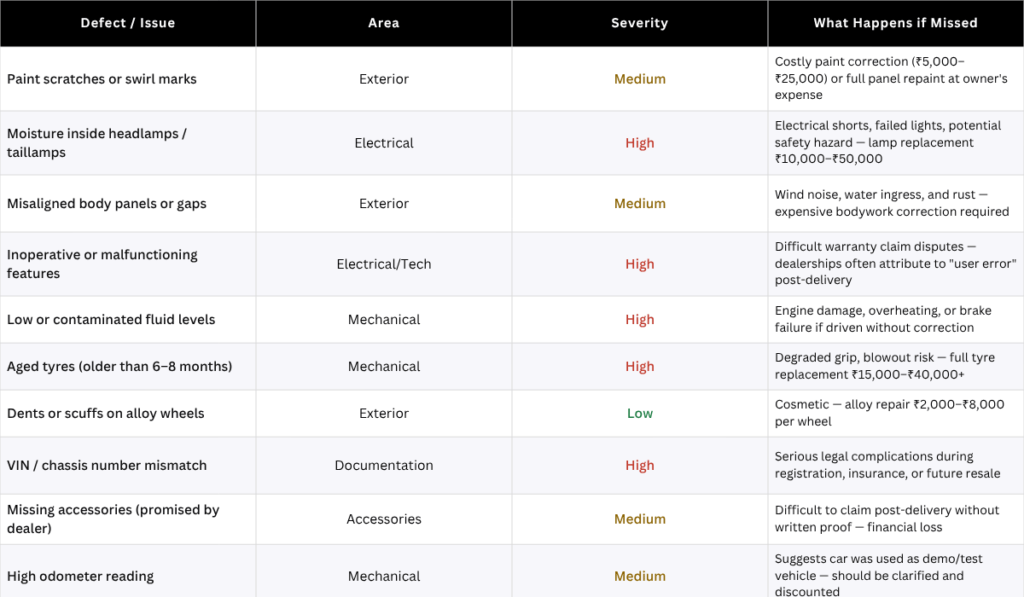
Common Defects Found During PDI in India
These are the most frequently reported issues discovered during pre-delivery inspections — defects that, if missed, would have become the buyer’s financial problem.
Also Read, Best bikes under 1.5 lakh in India
8 Expert Tips for a Bulletproof PDI
Schedule Your PDI in Daylight
Paint defects, swirl marks, and shade differences are nearly invisible under showroom fluorescent lighting. Always conduct your external inspection in direct natural daylight — preferably in the morning when light is even.
Do It Before Registration, Not After
The PDI must happen before the car is registered in your name and before any delivery paperwork is signed. Once the car is registered and handed over, it legally becomes your property — and your problem.
Bring a Knowledgeable Friend or Hire a Third-Party Inspector
Independent PDI services like CarVaidya inspect your vehicle with no dealership affiliation — providing an objective, honest assessment. The cost (₹1,500–₹3,500 typically) is tiny compared to what they can help you avoid.
Document Everything With Photos and Video
Record a complete walkaround video before signing anything. Take close-up photos of every panel, every wheel, the odometer, and the engine bay. This footage is your legal evidence if any dispute arises later.
Check the Tyre Manufacturing Date
Look for the DOT code on the tyre sidewall — the last four digits indicate the week and year of manufacture (e.g., 2424 = 24th week of 2024). Ideally, tyres should not be older than 6 months from your delivery date.
Don’t Let the Dealer Rush You
Dealership staff will often create a sense of urgency — other buyers are waiting, the RTO office closes soon, etc. Politely but firmly take all the time you need. A thorough PDI is your legal right as a consumer.
Get All Defects Documented in Writing
If the dealer acknowledges any defect — even minor ones — get them to sign a written document confirming they will rectify it before or after delivery. Verbal promises are nearly impossible to enforce.
Request a Detailed PDI Report
Ask the dealership for a copy of their own PDI report with all inspection points signed off. This serves as useful documentation for warranty claims, insurance, and future resale.
The Bottom Line — Never Skip Your PDI
🏆 Three Scenarios — What PDI Protects You Against
Is PDI mandatory for new cars in India?
PDI is not legally mandatory for buyers in India — but it is strongly recommended by every automotive expert and consumer advocacy group. Dealerships are expected to perform a basic PDI before delivery as part of standard operating procedure, but buyers have the right to conduct their own inspection or hire an independent PDI service before accepting the vehicle. Skipping a PDI means you have little or no recourse if defects are discovered after the car is registered in your name.
When should I do a pre-delivery inspection — before or after registration?
Always conduct your PDI before registration and before signing any delivery documentation. Once a car is registered in your name, it legally becomes your property, and demonstrating that any defect was pre-existing becomes extremely difficult. Inform the dealership when booking your delivery that you intend to conduct a pre-registration inspection. Most reputable dealerships will accommodate this without issue. Any dealer who refuses to allow a PDI before registration should be treated as a red flag.
How long does a pre-delivery inspection take?
A thorough PDI that includes all exterior, interior, mechanical, electrical, and document checks plus a test drive typically takes 1 to 2 hours. A basic visual check alone can take 30–45 minutes. Do not be rushed by the dealership — take as long as you need. The time invested in a proper PDI is insignificant compared to the cost of discovering defects after you have signed the delivery receipt and driven the car home.
Can I hire a third-party inspector for a PDI in India?
Yes — and it is highly recommended, especially for first-time buyers or high-value purchases. Third-party PDI services like CarVaidya and independent automobile inspectors operate across major Indian cities and provide unbiased, dealer-independent inspections. They are trained professionals who know exactly where to look for problems that an untrained eye would miss — from paint repaint indicators to underbody damage and electrical faults. The cost typically ranges from ₹1,500 to ₹3,500 depending on the service and vehicle type.
Is a PDI necessary for a used car purchase, not just new cars?
PDI is arguably even more critical for used car purchases than new cars. Industry data indicates that approximately 40% of used cars in India have an undisclosed accident history, 20–30% have tampered odometers, and around 15% have fabricated service records. A thorough inspection by an independent third-party PDI service can uncover paint repaint indicators, structural damage, underbody corrosion, engine wear, and documentation inconsistencies — all of which directly affect the car's value, safety, and your legal standing as its new owner.
How do I check if my new car's tyres are old or fresh?
Every tyre has a DOT code moulded into its sidewall. The last four digits of this code indicate the manufacturing date — for example, "2424" means the 24th week of 2024. Ideally, your new car's tyres should have been manufactured no more than 6–8 months before your delivery date. Rubber degrades even when unused, especially in India's extreme temperatures. Older tyres have reduced grip, increased cracking risk, and greater vulnerability to blowouts — which is a serious safety concern. If the tyres are older than 8 months, request the dealership to replace them or negotiate a discount accordingly.