
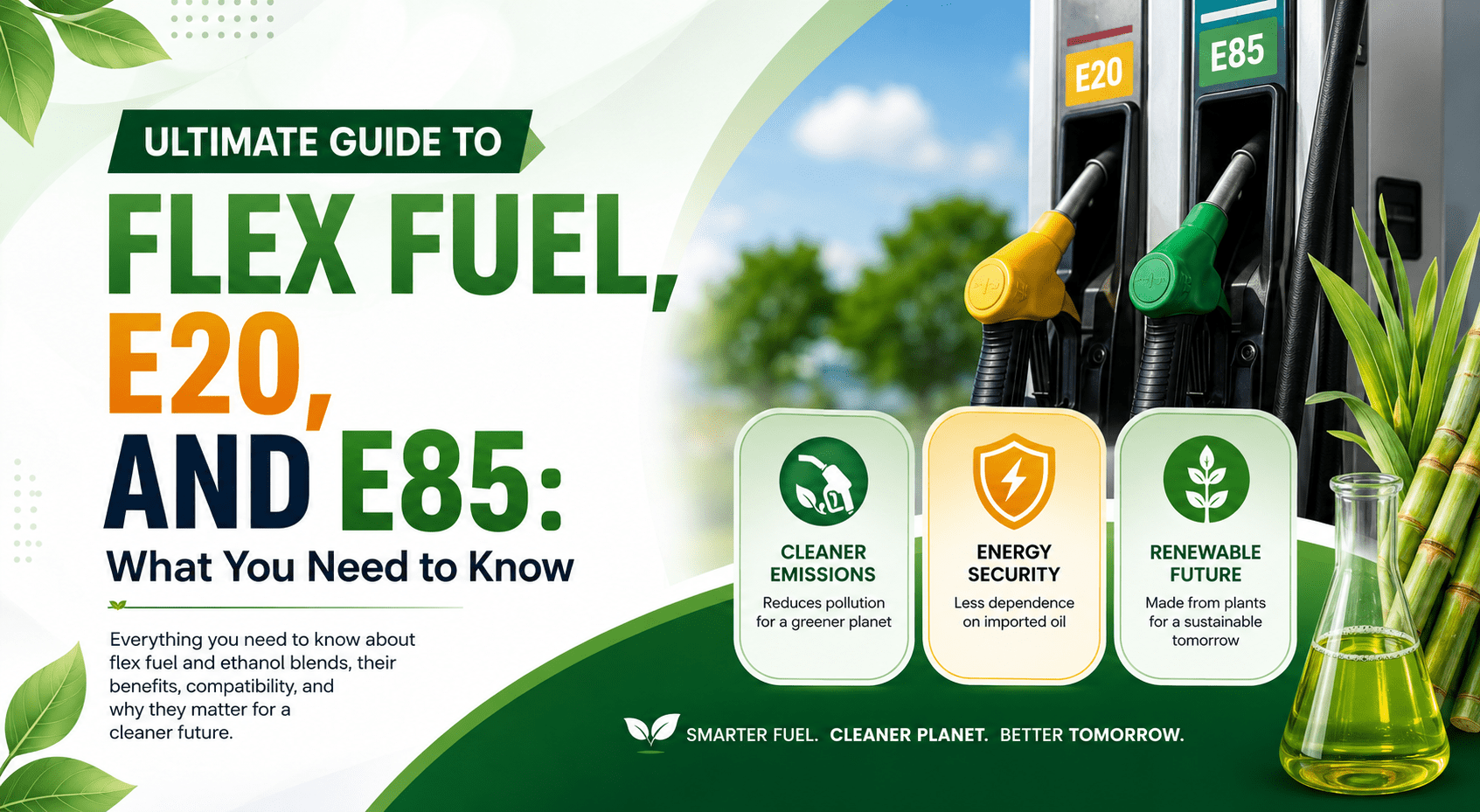
The automotive fuel landscape in India is evolving rapidly. With environmental concerns and government initiatives promoting ethanol-blended fuels, understanding the differences between flex fuel, E20, and E85 has become crucial for vehicle owners. This comprehensive guide breaks down each fuel type, their benefits, drawbacks, and implications for your vehicle.
Understanding the Three Fuel Types
Flex Fuel: What It Is
Flex fuel, commonly known as FFV (Flexible Fuel Vehicle) compatible fuel, is a generic term for vehicles designed to run on multiple fuel types. These vehicles can seamlessly switch between regular petrol and ethanol blends without manual intervention. Flex fuel vehicles use advanced engine management systems that automatically adjust fuel injection and ignition timing based on the fuel composition detected through oxygen sensors.
E20 Fuel: The Government's Push
E20 fuel contains 20% ethanol blended with 80% conventional petrol. Launched across India in 2023, E20 is part of the National Biofuel Policy aimed at reducing crude oil imports and promoting agricultural waste utilization. E20 is compatible with all vehicles manufactured after 2020, though older vehicles may experience compatibility issues. The fuel produces lower emissions and reduces India’s dependence on imported crude oil.
E85 Fuel: The High Ethanol Alternative
E85 fuel comprises 85% ethanol and 15% petrol. While common in North America and Europe, E85 remains limited in Indian markets. This fuel type requires specially designed flex-fuel vehicles to operate efficiently. E85 offers the highest renewable energy content but demands significant engine modifications and infrastructure development.
Detailed Comparison: Pros and Cons
E20 Fuel Advantages
- Lower cost compared to conventional petrol (typically 2-5% cheaper)
- Reduced carbon emissions and environmental impact
- Better octane rating, improving engine performance
- Compatible with modern vehicles (2020 onwards)
- Readily available at most fuel stations across India
E20 Fuel Disadvantages
- Slightly lower fuel efficiency (3-5% reduction in mileage)
- Potential corrosion in older fuel system components
- Higher ethanol content causes faster fuel degradation
- May cause starting issues in winter or cold climates
- Not compatible with older vehicles (pre-2020 models)
Flex Fuel Vehicles: The Balanced Approach
Flex fuel vehicles offer maximum flexibility, allowing drivers to choose between E0 (pure petrol), E20, and E85 based on availability and preference. These vehicles feature:
- Advanced engine control units
- Enhanced fuel injectors and pumps
- Corrosion-resistant fuel systems
- Superior performance across fuel types
E85: The Premium Option
E85 delivers exceptional performance benefits but comes with limitations:
- Highest renewable fuel percentage (85% ethanol)
- Superior engine knock resistance
- Excellent for high-performance engines
- Limited availability in India
- Higher consumption rates
- Requires dedicated flex-fuel vehicle platforms
Impact on Engine Performance and Longevity
E20 fuel burns cleaner than conventional petrol, reducing deposit buildup in engines. However, ethanol’s hygroscopic nature (attracts water) can lead to fuel system corrosion if left unused for extended periods. Regular engine maintenance becomes essential when using E20 consistently.
Flex fuel vehicles are engineered to handle ethanol’s corrosive properties through stainless steel fuel lines, specialized gaskets, and protective coatings. E85 vehicles require similar protection but at enhanced levels due to higher ethanol concentration.
Overcoming E20 Fuel Daily Use Challenges: Recommended Products
Using E20 fuel regularly requires protective measures to extend engine life:
1. Fuel System Cleaner Additives
Products like Liqui Moly Fuel System Cleaner or Redline Fuel System Cleaner help remove deposits caused by ethanol oxidation, maintaining injector efficiency.
2. High-Performance Synthetic Engine Oil
Switch to Mobil 1 Synthetic 5W-30 or Castrol Edge Full Synthetic, which provides superior protection against ethanol-related wear and corrosion.
3. Octane Booster
Fuel Octane Boosters enhance combustion efficiency and prevent knocking, optimizing E20 performance in older compatible engines.
4. Fuel Stabilizer
If your vehicle sits unused, add Sta-Bil Fuel Stabilizer to prevent water absorption and fuel degradation caused by ethanol’s hygroscopic nature.
5. Fuel System Protection Spray
Use Wynns or Redex Fuel System Protection to create a protective barrier against corrosion in fuel injectors and valves.
6. Premium Air Filters
K&N Reusable Air Filters improve air-fuel mixture efficiency when using E20, enhancing overall engine performance.
7. Fuel Filter Upgrade
Install high-capacity fuel filters like Bosch or Mann filters that effectively remove ethanol-related contaminants.
Conclusion
E20, flex fuel, and E85 represent the future of sustainable motoring in India. While E20 offers an accessible eco-friendly alternative for modern vehicles, flex fuel technology provides maximum flexibility. Choose based on your vehicle’s compatibility, driving habits, and environmental values. Use recommended protective products to maximize engine longevity when embracing ethanol-blended fuels.
Q1: Can I use E20 in my older vehicle?
It's not recommended for vehicles manufactured before 2020. Consult your vehicle's manual or manufacturer for fuel compatibility.
Q2: Which fuel provides better mileage?
Regular petrol offers the best mileage. E20 reduces mileage by 3-5%, while E85 may reduce it by up to 15%.
Q3: Is E20 damaging to my engine?
No, if your vehicle is E20-compatible. Modern engines are designed with materials that resist ethanol's corrosive properties.
Q4: What's the price difference between these fuels?
E20 is typically 2-5% cheaper than petrol. E85 pricing varies by region but is usually competitive with petrol.
Q5: Do flex fuel vehicles perform better with E85?
Yes, flex fuel vehicles optimized for E85 deliver superior performance, including higher horsepower and torque.
Q6: Is E20 better for the environment?
Absolutely. E20 reduces carbon emissions by approximately 12-15% compared to conventional petrol.
Q7: Can switching between fuels damage my engine?
Modern flex fuel vehicles handle switching seamlessly. However, mixing fuel types unnecessarily isn't recommended.
Q8: How often should I service my vehicle using E20?
Service intervals remain the same, but use high-quality synthetic oils to protect against ethanol's effects.