
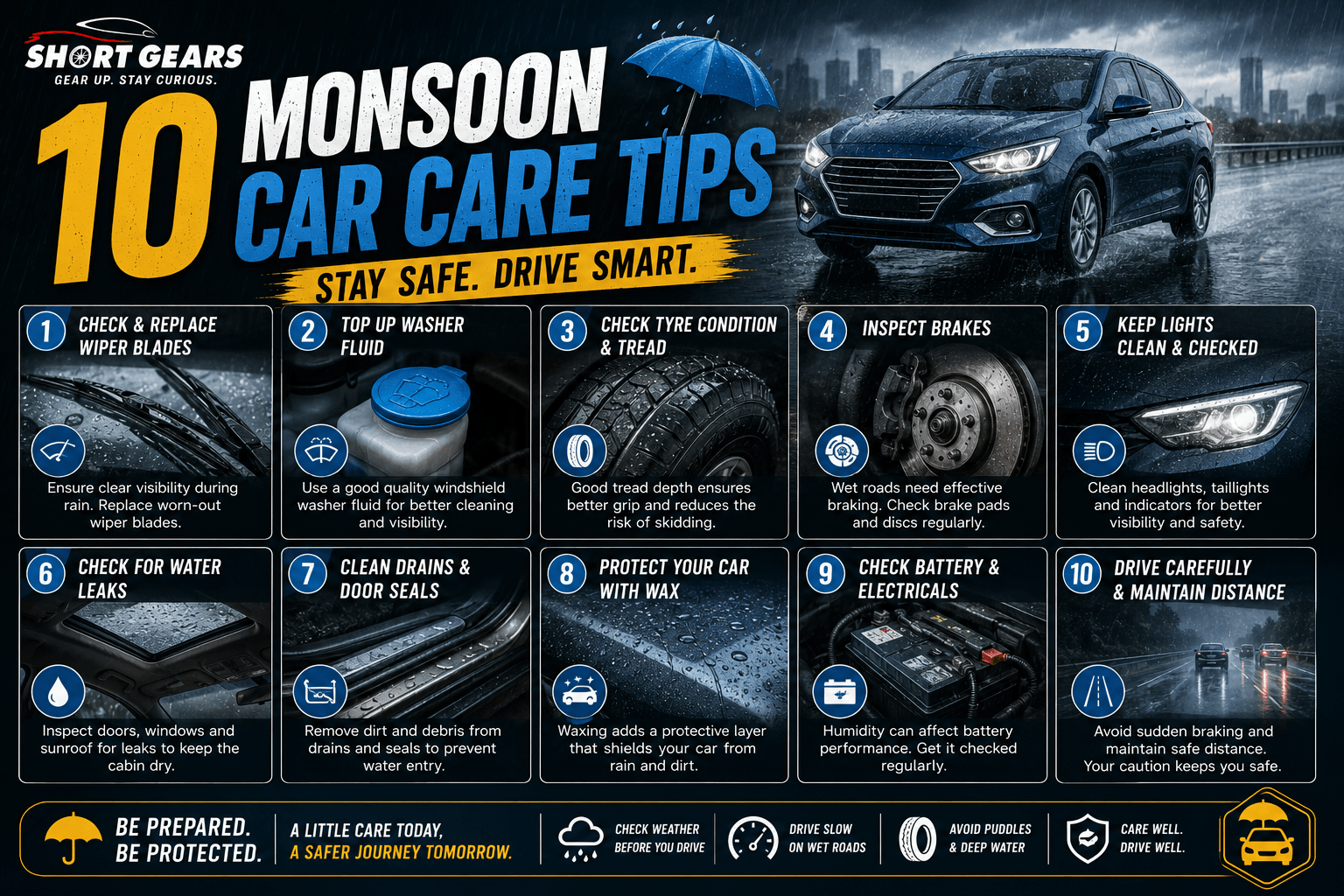
10 Monsoon Car Care Tips: Essential Tips for Keeping Your Vehicle Safe

You are currently viewing 10 Monsoon Car Care Tips: Essential Tips for Keeping Your Vehicle Safe

India’s monsoon season (June–September) is relentless on every car on the road. Acidic rainwater, waterlogged streets, mud, and 85–95% humidity accelerate rust, degrade brakes, and compromise visibility across all car types — from a Maruti Alto to a Mahindra Scorpio-N. Here are 10 essential tips that apply to every car you own, with specific callouts where SUVs, sedans, hatchbacks, or compact cars need different attention.

10 Essential Monsoon Car Care Tips

01. Inspect Tyres — Tread Depth & Pressure
Ensure a minimum tread depth of 1.6mm for compact cars and sedans, 3mm for SUVs on wet roads. Check tyre pressure weekly — rain causes rapid pressure fluctuation. Under-inflated tyres lose grip fast and risk aquaplaning on flooded roads.
02. Replace Worn Wiper Blades
Cracked or streaking wiper blades are the single biggest visibility hazard in heavy rain. Replace blades before monsoon — silicone beam wipers outperform traditional rubber blades in sustained downpours. SUVs and MPVs with rear wipers should check the rear blade too.
03. Check Brake Pads & Brake Fluid
Wet roads increase braking distance by up to 40%. Replace brake pads worn below 3mm. Check brake fluid level — absorbs moisture over time and reduces efficiency. SUVs and MPVs, due to greater vehicle weight, face amplified braking risk on slippery surfaces.
04. Apply Underbody Anti-Rust Treatment
Road spray and mud trap moisture against exposed metal. Apply underbody anti-rust coating before the first rain — cost ₹1,500–₹3,500 at a service centre. SUVs with larger undercarriage exposure need this more urgently than low-riding sedans and hatchbacks.
05. Test All Lights & Fog Lamps
Visibility in heavy Indian monsoon rain can drop below 30 metres. Verify headlights, brake lights, indicators, and fog lamps are fully functional. Clean hazy light lenses with a plastic polish — a dull lens cuts output by up to 50%.
06. Wax the Exterior & Apply Glass Water-Repellent
Acidic monsoon rainwater strips paint and etches glass. Apply a ceramic or carnauba wax coat to the body before monsoon. Use a hydrophobic glass sealant on all windows — rain beads off at speeds above 60 km/h, dramatically improving visibility without needing wipers.
07. Inspect Battery Terminals for Corrosion
Monsoon humidity accelerates battery terminal corrosion. Clean terminals with a baking soda solution, tighten connections, and apply dielectric grease. A weak battery that starts fine in summer may fail to start on a cold, wet monsoon morning — especially for diesel SUVs and MPVs.
08. Fix Door & Windshield Seals
Cracked door rubber seals let water seep into the cabin, soaking carpets and triggering mould. Compact cars, sedans, and hatchbacks are more prone to water ingress than high-riding SUVs. Check all door seals and windshield weather-stripping — replacement costs just ₹200–₹600 per door.
09. Check the AC & Cabin Air Filter
A clogged cabin air filter circulates damp, mouldy air and fogs windshields from inside. Replace filters before monsoon — most cost under ₹500. Run the AC in fresh-air mode (not recirculation) to defog glass quickly. On hatchbacks, this is especially critical due to smaller cabin volume.
10. Use Rubber Floor Mats & Keep Cabin Dry
Wet shoes, umbrellas, and damp clothing soak fabric floor mats — causing mould within 48 hours in India’s monsoon humidity. Switch to rubber/TPE mats (easy to rinse), keep silica gel packets in the cabin, and never store wet items on fabric seats for extended periods.

Never drive through waterlogged roads deeper than your car’s door sill. For most hatchbacks and sedans, that’s 150–200mm. If water enters the air intake, your engine can hydrolock — causing catastrophic, non-warranty damage. When in doubt, turn around.

Pre-Monsoon Quick Checklist — Do These Before First Rain

  • Tyre tread depth ≥ 2mm
  • Brake pads ≥ 3mm
  • Underbody anti-rust spray
  • Wax or ceramic coat applied
  • Cabin air filter replaced
  • Rubber floor mats installed
  • Wiper blades replaced
  • Battery terminals clean
  • All lights fully functional
  • Door rubber seals intact
  • Glass hydrophobic sealant applied
  • Emergency kit in boot

Pro tip: Book a pre-monsoon service package at your authorised service centre — most offer bundled checks covering brakes, fluids, underbody rust, AC filter, and lights for ₹2,000–₹5,000. Doing it once before monsoon is far cheaper than mid-season breakdown repairs.

Yes. SUVs have higher ground clearance but a larger underbody surface area exposed to road spray and mud. Prioritise underbody anti-rust treatment, check for mud trapped in body cladding (which retains moisture), and ensure rear wiper blades are replaced. Compact cars and hatchbacks need more attention to door seal integrity due to lower ground clearance.

Before monsoon, check: tyre tread depth and pressure, wiper blades, brake pad thickness, all lights, battery terminals, windshield water-repellent coating, underbody rust protection, door seals, and cabin air filter. This checklist applies to every car type — hatchback, sedan, compact, or SUV.

Avoid waterlogged roads if possible. If unavoidable, never enter water deeper than your car's door sill — typically 150–200mm for hatchbacks and sedans, slightly more for SUVs. Water entering the air intake can hydrolock the engine, causing severe and expensive damage.

Switch your AC to fresh-air mode (not recirculation) and direct airflow toward the windshield. Most cars have a dedicated windshield defog button. Applying an anti-fog solution to interior glass also helps. Avoid recirculation mode — it traps humid cabin air and worsens fogging rapidly.

Leave a Reply