
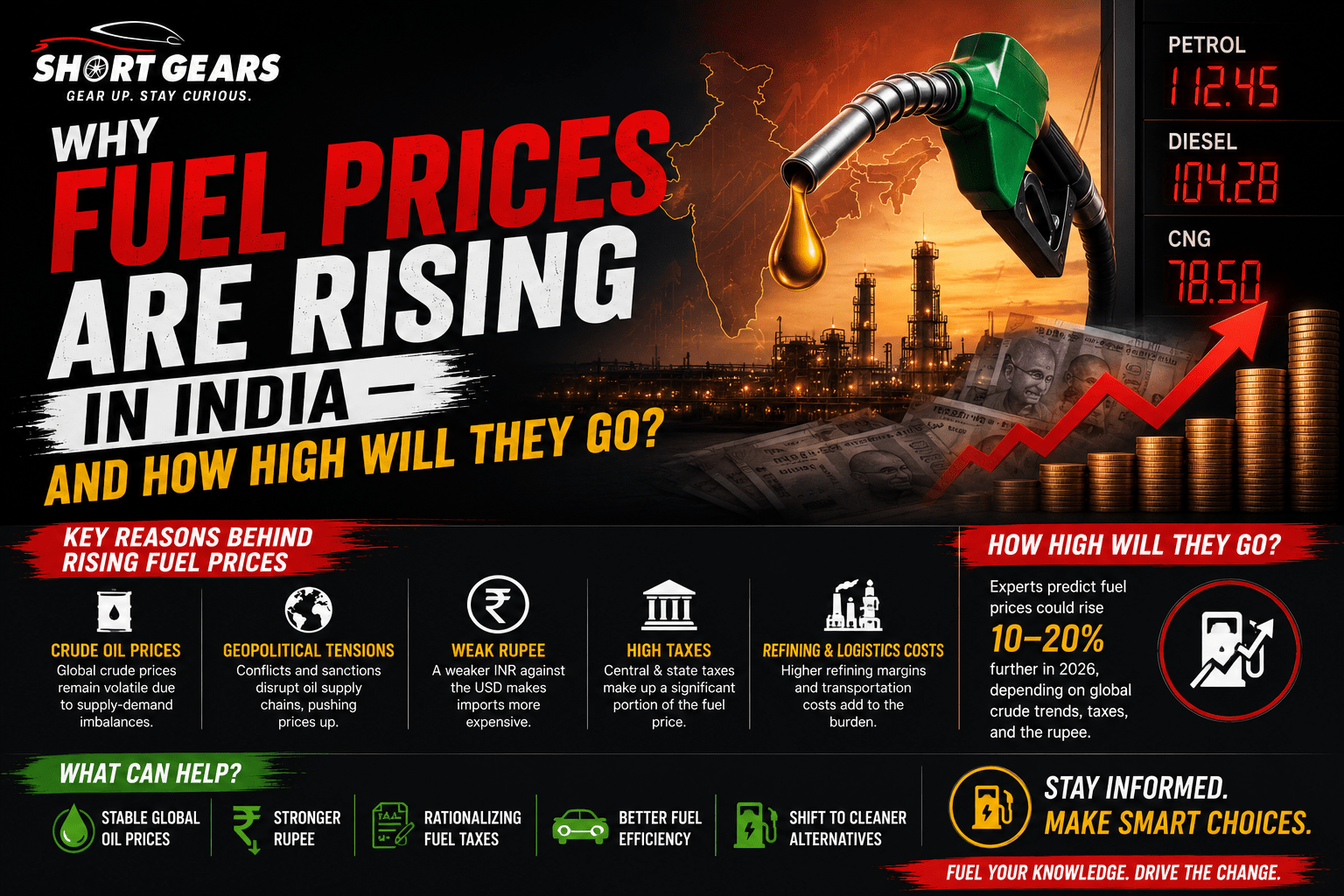
In just 11 days, petrol and diesel prices in India have climbed nearly ₹7.50 per litre — one of the sharpest fuel hike cycles in recent memory. From ₹94.77 to crossing ₹102 in Delhi, the pump shock is real. Here is everything you need to know about why it is happening, what it means for your wallet, and what comes next.
The Numbers at a Glance
₹7.50
Per litre — petrol & diesel
Latest Fuel Prices
Prices are revised daily at 6:00 AM by state-run Oil Marketing Companies (OMCs) — Indian Oil (IOC), Bharat Petroleum (BPCL), and Hindustan Petroleum (HPCL). City-level variation is driven by differing state VAT rates, local cess charges, and transportation costs.
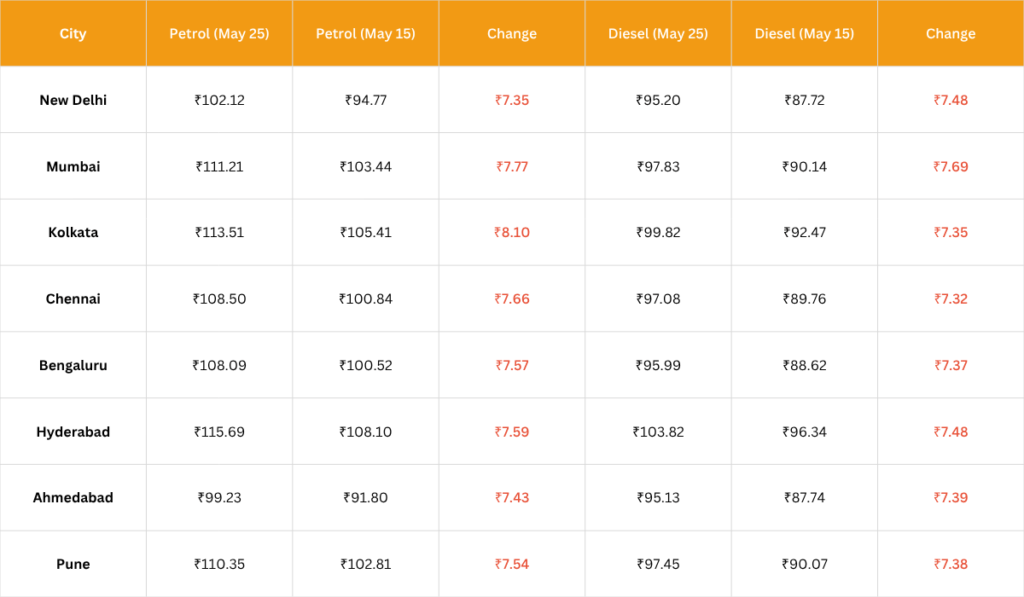
* Prices as of May 25, 2026 morning revision. May 15 figures are pre-hike baselines. Prices include central excise duty, state VAT, and dealer commission.
Also Read, Best Hybrid Cars in India 2026
Why does Hyderabad pay the most? Telangana levies one of the highest VAT rates on petrol in the country. Since state VAT is applied as a percentage of the final price, cities in high-VAT states pay a disproportionately larger absolute rupee amount when the base price rises.
What This Means for the Economy and You
Higher fuel costs are not an isolated consumer inconvenience. Diesel in particular is the circulatory fuel of India’s logistics economy — powering road freight, agricultural machinery, fishing vessels, and backup power generators. When diesel becomes expensive, everything transported by road becomes more expensive too.
Immediate Household Impact
A ₹7.50/litre hike translates to approximately ₹225–375 in additional monthly fuel spending for a typical two-wheeler owner filling a 30–50 litre tank, and significantly more for car owners. For daily wage earners and gig-economy workers who depend on personal vehicles, this represents a meaningful compression of disposable income.
Inflationary Pressure Across the Economy
Economists warn that sustained elevated diesel prices create a secondary inflation wave. Higher transportation costs are passed on by freight operators to manufacturers, retailers, and ultimately consumers. Essential commodities, agricultural produce, and FMCG goods all face upward price pressure when diesel rises — making fuel hikes a significant macroeconomic event beyond just the forecourt.
Impact on Transport, Agriculture & SMEs
Road Freight
Trucking costs rise immediately; transporters pass costs to shippers within days.
Agriculture
Irrigation pump sets and tractors run on diesel — farm input costs rise sharply.
Taxis & Auto-Rickshaws
Cab aggregators and auto drivers face margin pressure, potentially hiking fares.
Small Businesses
SMEs with delivery or logistics components face compressed margins or must raise prices
Also Read, Best Electric Cars Under 20 Lakh In 2026
What Happens Next? Three Scenarios
Scenario 1: Staged Corrections Continue (Most Likely)
OMCs implement further incremental revisions over coming weeks to recoup accumulated under-recoveries. Inflation rises modestly but stays within RBI tolerance. The government avoids a single politically visible large correction by spreading adjustments across multiple smaller steps.
Scenario 2: Crude Normalises, Prices Stabilise
If the Strait of Hormuz situation de-escalates and Brent crude retreats below $90 per barrel, the pressure for further retail increases diminishes. OMCs recover margins without additional consumer-facing adjustments, and the cycle stabilises. Political pressure to partially reverse hikes may re-emerge before upcoming election cycles.
Scenario 3: Sustained High Crude Forces Structural Reform
If global oil prices remain above $110 per barrel for an extended period, India’s freeze-and-correct pricing architecture becomes untenable. A structural shift toward full price deregulation — gradually transitioning the full cost burden to consumers while providing targeted subsidies to low-income households — may be forced onto the policy agenda.
FAQ's
Why are petrol and diesel prices rising in India in 2026?
The surge results from a confluence of factors: global crude oil prices crossing $110/barrel due to Strait of Hormuz tensions, a rupee trading at ₹96+ against the dollar amplifying import costs, and the unwinding of a near four-year retail price freeze that left Oil Marketing Companies absorbing massive daily losses. The four revisions between May 15–25, 2026 are a compressed catch-up rather than a new daily pricing trend.
By how much have fuel prices risen in May 2026?
Petrol and diesel prices have risen by approximately ₹7.50 per litre cumulatively across four revisions between May 15 and May 25, 2026 — making it one of the sharpest and fastest fuel price correction cycles in recent Indian history. In Delhi, petrol crossed ₹100/litre for the first time in this cycle, reaching ₹102.12.
Why do petrol prices differ between cities in India?
The OMC base price is uniform across India. What creates city-to-city variation is the state government's VAT (Value Added Tax) rate, which differs significantly across states, plus local cess charges and transportation/freight costs to supply fuel from refineries or depots to retail pumps. States like Telangana and Maharashtra levy higher VAT, making Hyderabad and Mumbai consistently more expensive than Delhi or Ahmedabad.
Which city has the cheapest petrol in India right now?
Among major metro cities, Delhi has the cheapest petrol due to its relatively lower VAT structure. Nationally, Port Blair in the Andaman and Nicobar Islands has the cheapest fuel in the country — around ₹82.46/litre — because union territories carry significantly lower tax burdens.
Are CNG prices also rising?
Yes, CNG prices have also been revised upward. CNG crossed the ₹80/kg threshold in the National Capital Region for the first time in history during this cycle. However, the most recent revision (May 25) did not include a CNG hike, with the previous CNG revision having occurred on May 23, 2026.
Is there any relief expected for consumers in the near term?
Potential relief could come from a reduction in central excise duty — which the government has used before to soften price impacts — or from a significant fall in global crude prices. However, with OMCs still recouping losses from the price freeze period, a full reversal of recent hikes is unlikely in the short term without a substantial fall in Brent crude below $85/barrel or a policy-driven excise cut.